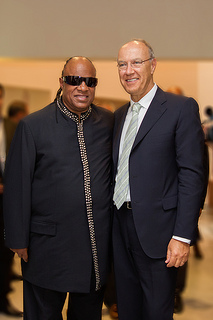
Matthew P. Sapolin, Commissioner of the Mayor’s Office for People with Disabilities, died of cancer on Tuesday 11/29/11 at the age of 41. Commissioner Sapolin was an inspiration for all people with disabilities. He refused to accept that his blindness caused him any limitations. In fact, he accomplished in his too- short lifetime more than many people I know, including being a drummer in the band he formed, serving as co-captain of the wrestling team at NYU, playing chess and becoming a marathon runner. He had a great sense of humor and was a big sports fan; he particularly loved baseball.
After losing his sight at a very young age, he attended regular classes in the Islip, NY school system, through the advocacy of his mother, so that he had the opportunity to interact with students without disabilities. I think that such an educational experience gave him the strength to realize that he had no limitations to achieve success in whatever he wanted to pursue.
I believe Matthew was the best advocate we have had in New York City for people with disabilities. He was a great negotiator, and was able to achieve significant victories for people with disabilities. Among his achievements were working to make the city’s building code more accommodating, initiating a rent freeze for some people with disabilities in New York city (Disability Rent Increase Exemption - DRIE) and initiating Disability Mentoring Day in New York City, which was held this year on October 19.
Matthew’s spirit was felt at his funeral, which had an overwhelming turnout of family, friends and colleagues on Friday, December 2 at St Patrick’s Cathedral. Mayor Bloomberg gave a most heartfelt eulogy; his words showed his admiration for Commissioner Sapolin when he said “nothing could stop Matthew” (view the original article here).
Personally, the Commissioner was an inspiration to me and the organization that I helped co-found, LD Resources Foundation. In 2009, he was my professor at CUNY’s graduate program in Disabilities Studies. He asked me if I had been able to read the books he had assigned for the class. I answered I had not read them, as they were not available in readable format with assistive technology. Matthew dismissed all the books that were not accessible and taught our class based on his experiences in life. It was the most amazing class I have ever taken.
Matthew became a mentor to me in my non-profit work, and an inspiration to many people in New York City. He taught me that disabilities are not a barrier for achieving success. I learned from Matthew how to negotiate successfully for resources for people with learning disabilities. As Disabilities Commissioner, Matthew was easily reachable at his office, and always had time to discuss an issue or question that was important to me. He was a supporter of LD Resources Foundation. His concern about helping people with learning disabilities helped me learn how to advocate with colleges and libraries to provide adaptive technology for people with LD.
Matthew, your spirit will be with us forever…

Sunday, December 4, 2011
Thursday, November 3, 2011
New Font Helps Dyslexics Tackle Reading
As published in the Scientific American (October 26, 2011), Jennifer Nalewicki wrote, "After years of fumbling while reading the written word, Christian Boer, a graphic designer from the Netherlands, has developed a way to help tackle his dyslexia. The 30-year-old created a font called Dyslexie that has proved to decrease the number of errors made by dyslexics while reading. The font works by tweaking the appearance of certain letters of the alphabet that dyslexics commonly misconstrue, such as "d" and "b," to make them more recognizable. This month Boer released the font in English for U.S. users to purchase online."
Monday, October 31, 2011
Congratulations to Dr. Stephanie Anne Timmer, Friend and Supporter of LD Resources Foundation
LD Resources Foundation is
pleased to congratulate our good friend and supporter, Dr. Stephanie
Anne Timmer, on qualifying to represent the USA at the London 2012
Paralympic Games. Dr. Timmer is a world-class Track and Field athlete,
competing in the 10,000, 1500 and 400 meter track events, as well as
shotput, javelin and discus field events. She won the gold medal in the
javelin and 10,000 meter run and the bronze medal in shot and discus
events at the 2011 USA Masters Outdoor Track and Field Championships in
Cleveland in the 40 and over division. Dr. Timmer is ranked in the top
10 in the world in all three of her field events among Paralympic
athletes. For those who do not know, Dr. Timmer is blind. Follow this link to read more about her athletic accomplishments.
Dr. Timmer is the Chairman and Co-Founder of Premier Literacy ( a division of Premier Assistive), a company whose mission is to enrich and improve the lives of millions of people worldwide by making information truly accessible through the use of affordable technology. Premier Literacy seeks to give people with disabilities access to today’s technologically oriented world. The company offers a comprehensive suite of products that are invaluable tools for persons with visual, cognitive and mobility challenges, including Learning Disabilities.
LD Resources Foundation and Premier Assistive Technology created a joint initiative in 2008 called the “Key to Access Award Program.” The focus of this partnership is to create and expand programs that maximize opportunities to provide literacy tools to students everywhere. LD Resources Foundation continues to expand access to digital literacy tools to greater numbers of students, higher education institutions in New York City and beyond, as well as to public service institutions, government bodies and corporations.
Dr. Timmer is the Chairman and Co-Founder of Premier Literacy ( a division of Premier Assistive), a company whose mission is to enrich and improve the lives of millions of people worldwide by making information truly accessible through the use of affordable technology. Premier Literacy seeks to give people with disabilities access to today’s technologically oriented world. The company offers a comprehensive suite of products that are invaluable tools for persons with visual, cognitive and mobility challenges, including Learning Disabilities.
LD Resources Foundation and Premier Assistive Technology created a joint initiative in 2008 called the “Key to Access Award Program.” The focus of this partnership is to create and expand programs that maximize opportunities to provide literacy tools to students everywhere. LD Resources Foundation continues to expand access to digital literacy tools to greater numbers of students, higher education institutions in New York City and beyond, as well as to public service institutions, government bodies and corporations.
Sunday, October 16, 2011
Impact of ADHD at Work and School, and Prevalence of Associated Conditions revealed in New Survey
PHILADELPHIA, October 12, 2011—New survey results reveal that Attention-Deficit/Hyperactivity Disorder (ADHD) impacts aspects of work and school for adults and children living with the condition. The survey also shows that many people with ADHD have been diagnosed with, or suspect presence of, other health conditions including anxiety, depression and sleep disorders. ADHD, which affects more than 13 million Americans, is a genetic, neurobiological disorder that results in challenges with attention, hyperactivity and impulsivity. The ADHD Awareness Coalition conducted the survey with the goal of increasing awareness and understanding of the disorder during ADHD Awareness Week, observed on October 16-22. They add that people with ADHD can live fulfilling lives with proper management of ADHD symptoms.
Wednesday, October 12, 2011
Technology and Disabilites
“Technology can be a double-edged sword. It may be more
efficient—in particular, in the communications arena, which is the subject of
this report—leading to an ever-rising demand for skilled workers, pushing the
college-wage premium ever higher. “…In this respect, a recent Harris
Interactive poll conducted for the Kessler Foundation and the National
Organization on Disability (NOD) is encouraging, reporting that the education
gap (the share of those with less than a high-school education) has narrowed
considerably between people with and without disabilities over the past two
decades, from 24 percent in 1986 to 6 percent in 2010 (Kessler
Foundation and NOD, 2010).”
From the National Council of Disability report,” The Power of Digital Inclusion:
Technology’s Impact on Employment and Opportunities for People with
Disabilities.
This report examines the importance of social media and other
information technologies in connecting people to job opportunities. Not
surprisingly, digital barriers to our networked economy can reinforce rather
than break down disproportionately low employment among people with
disabilities.
Friday, August 5, 2011
Project Eye to Eye pairs adults with LD to children with LD as mentors and role models
On a warm day in 1998 in Providence, Rhode Island, a group of LD/ADHD labeled college students from Brown University sat in a circle with a group of elementary school students labeled with learning disabilities from Fox Point Elementary. They were a part of a program called Project Eye-To-Eye, a public service project run by and for students with academic labels such as learning disabled (LD) and attention deficit hyperactivity disorder (ADHD). The program had one simple goal: match labeled adults with learning disabilities with labeled elementary school students to act as role models, tutors, and mentors as a means to empower their learning and give them hope for their future...
For more information on Project Eye to Eye,
Tuesday, August 2, 2011
Study Sheds Light on Auditory Role in Dyslexia By Pam Belluck
New York Times
August 2, 2011
Many people consider dyslexia simply a reading problem in which children mix up letters and misconstrue written words. But increasingly scientists have come to believe that the reading difficulties of dyslexia are part of a larger puzzle: a problem with how the brain processes speech and puts together words from smaller units of sound.ow, a study published last week in the journal Science suggests that how dyslexics hear language may be more important than previously realized. Researchers at the Massachusetts Institute of Technology have found that people with dyslexia have more trouble recognizing voices than those without dyslexia.
To read the rest of this article,click here
August 2, 2011
Many people consider dyslexia simply a reading problem in which children mix up letters and misconstrue written words. But increasingly scientists have come to believe that the reading difficulties of dyslexia are part of a larger puzzle: a problem with how the brain processes speech and puts together words from smaller units of sound.ow, a study published last week in the journal Science suggests that how dyslexics hear language may be more important than previously realized. Researchers at the Massachusetts Institute of Technology have found that people with dyslexia have more trouble recognizing voices than those without dyslexia.
To read the rest of this article,click here
Subscribe to:
Posts (Atom)